EMT Practice Test

1. Question Content...


Question List

Question1: You are the business analyst for your organization and you're creating the requirements package. In this documentation, to what level should you document the requirements for your stakeholders?

Question2: The human resources department of an organization needs a new report. The business analyst (BA) assigned to this effort has scheduled a requirements workshop with the users. Users from the legal department have also been invited to the workshop. As the BA sets up the workshop, what can be done in advance to ensure a productive and focused workshop?

Question3: Business needs do not always originate from the business analyst or from business owners. There are several stakeholders which may identify or contribute to the identification of a business need. Which one of the following stakeholders are most likely to have the most direct awareness of problems that could lead to a business need?

Question4: What type of requirements elicitation technique is the Delphi Technique?
Question5: You are working with the project stakeholders to analyze and prioritize their requirements for the project. One of the project requirements is to achieve a high-level of customer satisfaction for the project deliverable. What is the danger in this project requirement?

Question6: A business analyst (BA) is working on a project involving the purchase of a commercial off-the-shelf (COTS) product. All internal risks have been identified and assessed. What is the BA's next course of action?

Question7: A company has bought a customizable software product and the vendor's business analyst (BA) is visiting the company's office to perform a requirements assessment. The business sponsor expresses an interest in improving a specific process that is in scope. What should the BA do?

Question8: If you're a business analyst and using an event-based elicitation task, such as a requirements workshop, what can be considered as essential to establish with the participants?

Question9: A business analyst (BA) held a formal walk through of requirements developed on a project. Stakeholders expressed concerns because they had different interpretations of the requirements. What activity would help ensure a common understanding?

Question10: There are four inputs to the plan business analysis activities. Which one of the following is not an input to the plan business analysis activities process?

Question11: Martha is the business analyst for her organization and she's been asked to help create a SMART goal for her company. Which one of the following organizational goals could be considered SMART?

Question12: The business analyst (BA) has prepared a requirements package and it is now ready to present to the stakeholders. What is the purpose of presenting the package?

Question13: Beth is a business analyst for her organization and she's completing the tasks in the requirements management and communication knowledge area. As a result of these tasks, she'll create several things for her organization.
Which one of the following, however, is not one of the outputs of the requirements management and communication tasks?

Question14: Mark is the business analyst for his organization. He is working with the solution development team and he believes that the team does not want to implement a certain portion of the requirements. The team is expressing the difficulty of the requirements and how it will be extremely challenging to complete. When Mark asks about a similar project that the team completed, they insist that this is a different type of requirements though Mark believes that it is not. What is the solution development team appearing to do to the requirements?

Question15: Your organization is using a plan-driven approach to business analysis. What must you do with all of the communication documents created as part of this high-priority project that you are serving as the business analyst for?

Question16: A business analyst wants to elicit requirements from a large group of stakeholders. One of her primary goals of this event is to produce a broad set of options for solutions. Which elicitation technique would you recommend for this business analyst?

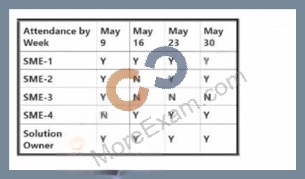
Question17: The following chart represents attendance of subject matter experts (SME) and the solution owner for a requirements review and approval meeting held weekly by a business analyst (BA).

The requirements package was approved by the solution owner during the May 30 meeting. After implementation of the solution, the BA learns that the users in SME-3 s area are not using the system. Which business analysis activity should the BA have monitored more closely to mitigate this situation?

Question18: You are the business analyst for your organization and you're preparing the solution for your organization's review and implementation. Some of the requirements of the solution, however, must be inspected by compliance officers before the project and implementation can move forward. The requirements of the inspection can be best described as what?

Question19: One of the tasks that the business analyst (BA) needs to complete is to maintain the requirements. As much as the BA values and sees the benefits of maintaining the requirements, the project manager (PM) does not see the same. In order to help the PM understand the value of this task, which following benefit of maintaining the requirements should the BA communicate to the PM?

Question20: An organization is planning to launch an exciting new service that has never been offered before. The expectations are that the service will be extremely popular with young families but, because the organization wants to keep it a secret until launch day. there is no way of knowing whether this is correct. Why does the business analyst (BA) suggest identifying high customer demand by young families as an "assumption?

Question21: A stakeholder has requested an extremely detailed resolution to an issue during current state analysis that may consume about 20% of the estimated project effort. How should the business analyst (BA) handle the situation?

Question22: There are three inputs to the business analysis planning approach process. Which one of the following is not one of the three inputs?

Question23: A business analyst (BA) must model information characteristics across multiple information systems for a project. What type of model captures this information?

Question24: A business analyst has determined that there are five possible solutions to a business need. If the business analyst completes the solution assessment on multiple solutions, what is the goal of the assessment?

Question25: Mary is the business analyst for your organization. She asks you what the purpose of the assess capability gaps task is. Which of the following is the best response to give Mary?

Question26: Stakeholders need a financial report that can be published and distributed to multiple end users. They would also like the report to be developed within a specific time frame and within cost. What must the business analyst (BA) do to achieve this goal?

Question27: What can be considered the only input to the task of defining assumptions and constraints?

Question28: A business analyst (BA) has completed multiple workshops involving a number of stakeholders including the project manager however, the elicitation results are inconsistent between the stakeholders. How should the variation in results be resolved?

Question29: Kendra is the business analyst for her organization. She's working with the project manager and the project sponsor to discuss the current requirements. Kendra believes it's important for the project manager to first implement the requirements with the highest amount of risks. Is this a good idea?

Question30: A business analyst (BA) is given an additional requirement near the end of the development phase that needs to be incorporated into the system as part of the same release. In this situation, the first activity the BA performs to understand the effect of the proposed change is to:

Question31: Stakeholder requirements where approved for a business process reengineering initiative along with the Creation of a | roadmap. Due to market conditions, the product roadmap is modified to move the default process to the next iteration. What should the business analyst (BA) modify in the stakeholder requirements?

Question32: A business analyst (BA) is tasked with performing a gap analysis between two existing systems to combine into a single system or run just one system. Which of the following modelling formats will show the requirements for both systems side by side?

Question33: A software company wants to make a gradual change from its traditional way of developing requirements to a more adaptive approach. A business analyst (BA) is hired to quantify the probability that the solution will meet the company's needs and assess the relevant risks. Which element of risk assessment does the BA need to consider?

Question34: A business analyst (BA) plans to organize a focus group to bring all the interested parties together and discuss the issues and possible risks for the new initiative. Due to the geographical differences of each participant a videoconferencing service will be used to satisfy stakeholder preferences. Which approach is the BA defining?

Question35: A solution that was implemented several years ago has achieved its stated objective of consolidating data from multiple sources. However, end user feedback reveals problems and inefficiencies. What should the business analyst (BA) do first?

Question36: A lead business analyst (BA) has received negative feedback on the deliverables produced by BAs in the organization. A major concern was ambiguous requirements. What technique will help ensure business analysis information is clear and understandable?

Question37: Which one of the following statements best describes requirements prioritization?

Question38: A business analyst (BA) is verifying a set of requirements. One of the requirements is "After the customer has received an email confirmation, the customer is likely to access the order status in the order history which is available upon order submission." Which one of the following requirements quality characteristic is breached?

Question39: You are the business analyst for your organization and you are working with Bill on creating a model. Bill is a little confused about all the different things a model can do for the stakeholders. You explain to Bill that a model can do all of the following except for which one?

Question40: You are a business analyst in an organization that has recently embraced business analysis as part of its initiative for new projects. In this organization, there is not an organizational standard for tailoring business analysis duties and expectations. Which one of the following best describes the action that you should take to begin business analysis?

Question41: According to 'A Guide to the Business Analysis Body of Knowledge', when should the business analyst and an organization actually start requirements allocation?

Question42: Which of the following is an output of the Identify Stakeholders process?

Question43: When you, a Business Analyst, work with your stakeholders, team, and experts to define the business analysis activities, what thing do you actually define?

Question44: Before requirements can actually be approved to be managed, what must be true about the requirements?

Question45: A business analyst (BA) is working on a set of tasks to establish a governance process for the project. The BA intends to identify who has authority and responsibility to propose changes, who should be involved in the change discussions, and how changes will be documented and communicated. Which of the following are the inputs that would help the BA complete the task?

Question46: Henry is a business analyst in his organization and he's asked an expert to help him determine the best business analysis duties to implement. Why would Henry ask an expert to help him define the business analysis duties?

Question47: The Chief Information Officer (CIO) of a large financial services firm with many technology applications was formally reviewing all ongoing projects and noticed that the requirements were complex and difficult to follow. The CIO asks the business analyst (6A) what would improve the stakeholder's ability to understand the requirements. Which of the following will improve the requirements quality?

Question48: Which of the following is a business management strategy originally developed by Motorola, USA in 1986?

Question49: Why is it important to have a requirements signoff process for approved requirements?

Question50: Due to a change in regulation, a solution being implemented has a new compliance requirement that must be evaluated. The requirements change strategy focuses on total cost of change as the primary driver for decisions. The business analyst (BA) compiled the following impact assessment of the proposed change based on the new compliance requirement.

What recommendation should the BA make to the stakeholders based on the above information?

Question51: Henry is the business analyst for the UUH Organization. Currently Henry is working on several work products as part of the requirements development process. He may need to share these work products with the stakeholders. Which of the following is not an example of a work product?

Question52: An organization's board of directors has funded a new mobile application to support external customers. The business case was developed with emphasis on objectives to broaden the organization's brand and increase customer engagement. The business analyst (BA) is reviewing a group of user stories with the product owner.
One of these user stories is: "As a customer service representative, I need to enter my time on the mobile application so that I can leave work to pick up my sick daughter from school". The product owner wants to take advantage of this opportunity to provide the staff a way to enter their time away from the office and create an interface to the Payroll application. How must the BA evaluate alignment with the existing scope?

Question53: During planning, elicitation, and sign off of requirements, the stakeholders felt that their opinions were not heard and information was not frequently shared. What major competency was lacking in this process?

Question54: A business analyst (BA) has been hired to validate a project's requirements. A series of meetings with stakeholders have been scheduled to walk through each requirement as it relates to the desired future state of the organization. The desired outcome of this exercise is to ensure that all requirements:

Question55: What do business goals and objectives of enterprise analysis actually describe?

Question56: A business analyst has been assigned the task of developing a model of the current state of an organization.
The business analyst doesn't understand why a current state may be needed. All of the following are good reasons to create a current state model of an organization except for which one?

Question57: Complete this statement. Policies and rules serve as boundaries and the organization and the operation of the organization.

Question58: As a candidate for CCBA, you should be able to recognize the activities associated with each knowledge area.
Which of the following is an elicitation process that is a part of job observation?

Question59: You are the business analyst for your organization and you're preparing to elicit requirements from the stakeholders. You've gathered several inputs to help with the elicitation process. Which input(s) will be used to ensure that you understand the type of information that should be elicited from the stakeholders?

Question60: You are the business analyst for a smaller project where there are few requirements. Management would still like you to create a method to trace the few requirements for this project. What type of matrix would be best in this instance?

Question61: Project work is taking place to evaluate whether a system's requirements can be met via creating internally, purchasing from others, or a combination of the two. What goal is addressed by this analysis?

Question62: What elicitation technique is best described as a study to compare the strengths and weaknesses of an organization against its peers and competitors?

Question63: When do change requests generally increase in a project?

Question64: A project aiming at improving an organization's Net Promoter Score is nearing completion. The business analyst (BA) and stakeholders are evaluating ways to measure the performance of the solution. Which technique may be employed?

Question65: In a project meeting, stakeholders presented conflicting views on how the business analysis process should be conducted, leading to the sponsor becoming very upset. If a similar situation arises in the future, what can the business analyst (BA) do to avoid the situation?

Question66: You're organizing the business analysis approach for your organization. Jane wants to know when changes to requirements are most likely to happen in business analysis processes. Which one of the following statements best describes when changes to requirements may happen?

Question67: The business analyst (BA) is analyzing the formal relationships between people working in the enterprise.
Which technique will the BA use to perform this task?

Question68: Ralph is a business analyst for his organization and he's using the plan-driven approach for business analysis.
Ralph has captured the requirements of the project, but what must happen before he can begin capturing and defining the requirements at a deeper level of detail?

Question69: You are the business analyst for your organization and you're working with Adam on business analysis processes. Adam is steeped in knowledge regarding the project's purpose. Of the following, what type of business analysis stakeholder is Adam?

Question70: The Chief Executive Officer (CEO) of a company presents a new corporate strategy that will introduce a new system to the organization. The CEO has expressed a concern about the impact to the staff once the strategy has been implemented. What must the business analyst (BA) do to address concerns of the CEO?

Question71: You are a business analyst for your organization. Your current business analysis endeavor includes working with stakeholders located in offices around the world. Because these stakeholders are dispersed, what is likely to increase in this endeavor as opposed to a collocated group of stakeholders?

Question72: A business analyst (BA) is negotiating and resolving conflict with stakeholders to ensure they participate in the required BA activities. Which element of stakeholder management is the BA performing?

Question73: A business analyst (BA) is informing stakeholders about the importance of quality when eliciting requirements. What characteristic describes a quality requirement?

Question74: A business analyst (BA) has decided to use a passive/unnoticeable job shadowing elicitation approach. What is an advantage of using this technique?

Question75: Which of the following is the best definition of the business rules analysis?

Question76: A business analyst (BA) is tasked with developing requirements that can be implemented by the development team iteratively. Which characteristic should the requirements exhibit?

Question77: There are three inputs in the plan business analysis approach. Which one of the following is not one of the three inputs?

Question78: Which of the following is used as a means of validating a created, selected, or tailored business analysis approach?

Question79: During the analysis, synthesis, and refinement of elicitation results the business analyst (BA) has discovered that some information is missing. Which course of action would resolve the situation?

Question80: You are the business analyst for your organization. You are coaching Tom about the different approaches to business analysis. Which type of business analysis approach has the most business analysis work at the beginning of the project or during the start of a project phase?

Question81: You are a business analyst for your organization and you're working with the stakeholders to identify the primary inputs to the business analysis approach. Which one of the following is a primary input to the business analysis approach?

Question82: A global organization is implementing a new Knowledge Management System and communication to the different regions has been informal. The approach is to convert the few remaining regions iteratively. The team has experienced variances at this point but feels confident in these final conversions. How should the business analyst (BA) communicate the information?

Question83: A business analyst (BA) needs approval for the requirements which were elicited, collated, and verified by a peer. The BA needs to understand the approval process and appropriate stakeholders who have the authority to approve the requirements. Which of the following artifacts contains this information?

Question84: A business analyst (BA) is developing requirements for a project with a limited budget. The business owner will be prioritizing requirements so that low value requirements can be de-scoped and the project remain within budget. Which of the following should the BA take into account to facilitate prioritization and ensure business objectives are met?

Question85: A business analyst (BA) is working on a project to provide a temporary solution that will last for two months.
The BA is feeling overwhelmed with the work needed to create the huge number of links to provide full traceability from solution requirements to design for this solution. How can the BA justify omitting all possible links?

Question86: You are the business analyst for your organization and you're notifying the key stakeholders of a need to gather requirements for an endeavor. One of the stakeholders that you'll need to attend your requirements workshop is the project manager. What role will the project manager have in this workshop?

Question87: The business analysis (BA) team is evaluating a new commercial off-the-shelf (COTS) application that will be implemented in the coming months. The company has over 20 legacy systems deployed. The Chief Information Officer (CIO) is worried about the need for integration and that some key linkages are missing.
What is the BA team evaluating?

Question88: You are the business analyst for your organization and you're working with several stakeholders to identify, manage, and approve requirements. Your organization requires using a plan-driven approach to business analysis and changing management. In this approach, who is most likely to approve changes to requirements?

Question89: A business analyst (BA) is creating a business process model (BPM) showing how the organization will handle errors reported on its website. The BA held a workshop with stakeholders about how the process might work. The BA was also given an instruction manual about a similar error-handling situation, but was advised that some minor aspects are not applicable to the new process. How can the BA use the manual?

Question90: A business analyst (BA) is assessing risks on a project addressing the implementation of a new web portal.
Which of the following would the BA classify as a project risk?

Question91: According to the book 'A Guide to the Business Analysis Body of Knowledge', effective business analysis practices can do what to the amount of change to requirements in a stable business environment?

Question92: Kelly is the business analyst for her organization and she's identifying roles and responsibilities of the people involved in business analysis activities. Her manager has asked Kelly to create the RACI matrix to accomplish this task. What is the RACI matrix?

Question93: When a business analyst hosts a structured walkthrough of the requirements, what should the walkthrough always include at the beginning of the process?

Question94: A business analyst (BA) begins to suspect that the ongoing elicitation activities with stakeholders are not delivering the quality of business analysis information required due to a lack of stakeholder participation.
What type of technique can the BA adopt to resolve this type of issue?

Question95: A business analyst (BA) is working on a project that follows incremental and iterative approaches. The BA and the stakeholders have shortlisted several user stories to be considered in the project scope. Which of the following methods would enable them to arrive at a common understanding on delivering value in the product and ranking the stories?

Question96: A government agency has initialed a project to implement a customer registry that will be shared across multiple agencies. Early estimates indicate there will be hundreds of requirements. While determining the requirements traceability approach, what factor takes precedence?

Question97: A new regulation is introduced that the project must comply with to remain competitive and industry compliant. Management wants to understand the effect of this new requirement on the project. What will the business analyst (BA) use to evaluate the change?

Question98: The Chief Executive Officer (CEO) is concerned about how two client bases are going to be integrated and serviced in the newly formed company after a merger. A project has been initiated to implement a Customer Relationship Management (CRM) system for the new company that will contain the client information from both companies. What must the business analyst (BA) do to address the concerns of the CEO?

Question99: Which of the following is the prime purpose of the Manage Stakeholders Expectations process?

Question100: You are the business analyst for your organization. Management has asked you to define and document the requirements of an endeavor so that the requirements may be reused again in the organization. Why would an organization want to re-use requirements?

Question101: The process of defining the business need uses one output. What is it?

Question102: A business. analyst (BA) is working on a project to implement a commercial off-the-shelf application for tracking customers. In an observation session with a Domain subject matter expert (SMF). the BA notes that the SME keeps separate records for the customers who are also vendors. The BA knows that the new software has a module for vendor management that would integrate the vendor and customer records. Which type of opportunity has the BA identified?

Question103: A business analyst (BA) is proposing design options and a number of opportunities are occurring that need to be understood further. One particular opportunity will prevent different stakeholders from performing the same function in distinctly different ways. What type of opportunity is this?

Question104: During a project to replace an existing system, requirements for new functionality were elicited. Upon further investigation, additional types of requirements related to other features and characteristics were also identified.
What can facilitate effectively understanding the different types of requirements?

Question105: While gathering information during a requirements workshop, a subject matter expert states that it is likely that an organizational restructure will occur in one of the business departments that will be utilizing parts of the new system. As such, the business analyst (BA) should:

Question106: A business analyst (BA) asked two stakeholders with approval authority to approve the requirements. The stakeholders are being asked to confirm that:

Question107: Which solution scope creation technique can be best described as the depiction of the scope of work required to integrate the new solution into the business and technical environments?

Question108: You are the business analyst for your organization. You are currently working with Susan on creating a model as part of the specify and model requirements process. Susan doesn't understand why you need a model. You explain to Susan that a model is just a simplified representation of a complex reality that is useful for understanding that reality and making decisions regarding it. In fact, you tell Susan, model can do all of the following except one option. Choose the option that model cannot do?

Question109: Which one of the following statements best describes the purpose of allocating requirements?

Question110: You are the business analyst for your organization and management has asked you to select a model for your solution. Management wants you to describe the people within and without of your organization who will interact with the solution. What type of model has management asked you to create?

Question111: A recent survey shows that a newly implemented system has features that the users have never used. Upon reviewing the survey report, the Chief Executive Officer (CEO) highlighted that the company must avoid future implementations with functionality that does not provide any business value. What must the business analyst (BA) do to ensure future requirements meet a business need?

Question112: According to 'A Guide to the Business Analysis Body of Knowledge', the two most common data models are the entity-relationship diagram and what other model?

Question113: A business analyst (BA) is in the process of specifying the confirmed results of a requirements elicitation workshop. Which of the following help to ensure that the correct information about the requirements is provided to the participants?

Question114: Nancy has asked you to trace a particular requirement for her. What does 'to trace a requirement' mean?

Question115: You are the business analyst for your organization and you've been working with several stakeholders to gather requirements for approval.
The requirements have been approved with the exception of a conflict on one requirement. What must you and the stakeholders do in regard to this conflict before the business analysis endeavor may continue?

Question116: All of the following are inputs to the task assess organizational readiness except for which one?

Question117: A finance manager wants to begin a new project to replace the existing expenses processing system. The finance manager feels that the current expense submission-to-reimbursement process takes too long and is substantiated by 50% more complaints regarding incorrect reimbursement amounts than the same time last year. What should the business analyst (BA) investigate first?

Question118: When a business analyst performs requirements tracing, he may need to trace the requirements backward through their lineage and may need to trace the requirements forward through their relationship to other requirements. What is the backwards tracing activity called in requirements traceability?

Question119: You are the project manager of the NGQQ Project for your company. To help you communicate project status to your stakeholders, you are going to create a stakeholder register. All of the following information should be included in the stakeholder register except for which one?

Question120: You are the business analyst for your organization and your manager has asked you to prepare an analysis of each proposed solution. Your manager wants you to determine whether and how each option can provide an expected business benefit to meet the stated business need. What is your manager asking you to create?

Question121: When a business analyst performs requirements tracing, he may need to trace the requirements backward through their lineage and may need to trace the requirements forward through their relationship to other requirements. What is the forward tracing activity called in requirements traceability?

Question122: A long-established company selling ice cream is entering its crucial sales period leading up to summer. Based on the company's risk tolerance, a business analyst (BA) has advised against replacing the most popular flavors with new untested flavors. What is the company's attitude toward risk, as assessed by the BA?

Question123: A project is being initiated to enhance an on-line product because sales have declined for over a year. The company leader's ant confident that all of the skills needed to improve the product exist within the company.
By enhancing the product, sales will increase and new customers will emerge. A business analyst (BA) will help the enhancement project by first:

Question124: The business analyst (BA) has documented the requirements for a new system and is preparing the requirements for approval. Which of the following helps ensure that requirements are fully understood and traceable?

Question125: A team of business analysts (BAs) identified policies that dictate how the organization grants paid time off for its employees and the associated business rules. What is this team of BAs trying to do?

Question126: A business analyst (BA) is working on an effort to upgrade a system to take advantage of new technology.
Most of the end users with the business knowledge and IT staff with technical knowledge of the system are no longer with the company. What can the BA evaluate to better understand the extent of the effort?

Question127: Two business analysts (BAs) are working on a requirement elicitation activity. One BA comes across a checklist that contains stakeholder details such as who are involved, location, group dynamics that are to be considered before beginning the elicitation activity and seeks a clarification from the second BA. The other BA explains that these details, along with several other items mentioned in the checklist, are required to:

Question128: You are the business analyst for your organization and you're working to identify all of the stakeholders within your organization and outside your organization to ensure that you've captured the correct requirements for a project. Which one of the following techniques can be best suited for identifying stakeholders?

Question129: The business analyst (BA) has an item logged in the action items register requiring the verification of forthcoming legislation in the next 3 months that might have an impact on the proposed architecture. What should the BA do next?

Question130: A business analyst has determined that a project should be worth $2,750,000 in four years if her company decides to pursue the project. Assuming the rate of return on the investment is six percent, what is the minimum amount of funds the organization should invest in this project?

Question131: All of the following are documented approaches to business analysis work except for which one?

Question132: In order to begin defining the solution scope, you'll need four inputs. Which one of the following is actually a task that will use the solution scope and is not an input?

Question133: You are the business analyst for a new project. Part of this project is for the project team to manually install new workstations through the company's campus. Based on your research you have determined that the project team can install 25 new workstations per hour. Since there is a fixed amount of time that these workstations need to be installed you are considering adding additional labor for the implementation. You are also considering to adjust the prioritization of the project requirements based on the amount of workstations the project team can install per hour. What does the 25 workstations per hour represent in this scenario?

Question134: A business analyst (BA) has developed requirements for a project containing sensitive information. The requirements were approved and the solution was implemented. What should the BA do to ensure these requirements are maintained for future reference?

Question135: Verification of requirements on the projects have highlighted an issue regarding misunderstanding of design models among key stakeholders. A major reason cited for the misunderstanding was the technical jargon and models used in the documentation. What must the business analyst (BA) do to improve the understanding?

Question136: Sam is the project manager of the NHT Project. His project has stakeholders from the end users, server administrators, functional managers, external customers, technicians, and executive managers. In this high- profile project, which group of stakeholders is the most important?

Question137: The business analyst (BA) has traced the requirements for the interaction between a customer and the new online ordering system. Besides enabling the BA to ensure quality of the requirements to stakeholders, tracing the requirements will also enable the BA to:

Question138: A domain subject matter expert (SME) describes a scenario to the business analyst (BA) that may need to be considered for an impending change. The BA and domain SME sketch out the process model for this exception scenario for consideration. What action does the BA take?

Question139: Enterprise analysis creates just five outputs. Which one of the following is an output of the enterprise analysis tasks?

Question140: A business analyst (BA) is preparing an analysis approach to replace a 12-year-old air traffic control system.
The BA aims to define the solution definition before implementation, capture the information in standardized templates, and ensure that all activities are identified first and then divided into tasks. Which approach provides the appropriate level of formality for this project?

Question141: You are the business analyst for your organization. You are currently identifying opportunities for a customer to improve their business processes. The customer wants to streamline their business efforts either through new technologies, better processes, or a combination of both. The customer demands, however, that the solution should not cost more than $300,000 to implement and support for one year. What does the $300,000 represent?

Question142: A business analyst (BA) has been tasked with examining and analyzing the relationship between a set of requirements by verifying that they are unambiguous. What will the BA be looking for?

Question143: A one-location restaurant has been a huge success and the owner wants to expand into more markets. The owner wants to ensure that the quality of the food and pleasing atmosphere is maintained without introducing new variables. Working with the key members of the organization, the owner determines that training and standard processes must be defined. The owner engages a business analyst (BA) to create training materials and operating procedures based on the existing processes at the original restaurant. During this documentation, the BA identifies some opportunities for improvement. How must the BA proceed?

Question144: You are a business analyst for your organization and you're working with Mary. Mary wants to know what you need to complete the process of planning the business analysis approach if you're already the business analyst for your organization. This approach helps to find out the following except for which one?

Question145: When can changes to requirements occur in a business analysis planning and monitoring assignment?

Question146: A business analyst (BA) is facilitating a meeting with subject matter experts (SMEs) in which the SMEs are answering questions about the major business processes and associated activities the business performs. The BA will create a deliverable from this discussion that will assist in defining scope. What technique is the BA using?

Question147: Bradley is working with the business analyst Marsha to prioritize requirements for their organization. Marsha insists that the requirements be ranked on the cost-benefits analysis of the relative value to the organization.
What type of prioritization approach does Marsha want to use in this scenario?

Question148: An organization has invested $750,000 into a technology to help secure, automate, and communicate customer ordering. The solution has worked well for the past six months, but a newer technology has been developed that surpasses the abilities of the current solution and solves many defects and issues the company has with the existing solution. Purchasing the newer solution, however, means that the company will have to discard the solution that's only been in place for the past six months. What term can be assigned to the monies already implemented into the existing solution?

Question149: A business analyst (BA) is measuring solution performance of a new system. What should the BA consider to avoid skewed results and an inaccurate conclusion?

Question150: For a new account payable (AP) solution, the solution owner has provided the business analyst (BA) with goals the AP management team would like the solution to support. To ensure the solution meets these needs, the BA documents key performance indicators (KPIs). Which of the following is an example of a KPI?

Question151: A business owner has identified a high priority requirement that needs to be implemented immediately. The project manager has asked the business analyst (BA) to perform an impact analysis of this change. Which factor will the BA need to consider?

Question152: An organization is engaged in an effort to streamline the online customer experience. The business analyst (BA) prepares a business analysis information package to discuss the changes the customer will experience.
Which one of the following tools will assist the BA in this discussion?

Question153: A business analyst (BA) is modelling requirements to assist the stakeholders in visualizing the appearance and capabilities of a planned solution. What technique is the BA using?

Question154: What term is given to the collection of notes and diagrams used by the business analyst to develop the requirements during the requirements development process?

Question155: A change is desired in a project after the requirements are signed off and after technical design has started. The stakeholders want an additional product to be developed as part of the project. What tool can be used by the business analyst (BA) to assess the impact of the change?

Question156: A business analyst (BA) needs to make sure that the business analysis information is securely stored and accessible to stakeholders. Which element helps in achieving that goal?

Question157: A change to support a regulatory requirement is proposed for inclusion in the scope of a project. A business analyst (BA) conducts an impact analysis to determine the extent of the change. What previous task could assist the BA in performing the impact analysis?

Question158: A project team needs to maintain the traceability of requirements for a software system. Due to the large number of requirements, which of the following methods should the team use?

Question159: The business analyst (BA) has structured information so it is easy to find, does not conflict with other information, and is not duplicated unnecessarily. Which additional factor does the BA need to take into account when deciding how to structure the information?

Question160: A business analyst wants to host a brainstorming session with eight key stakeholders. In preparation for this event, the business analyst should designate which one of the following rules for the session?

Question161: According to the business analysis book 'A Guide to the Business Analysis Body of Knowledge', which your exam is largely based on, almost all methodologies fit somewhere along a spectrum between plan-driven and what other methodology?

Question162: When a business analyst completes the task of organizing requirements, he is completing two key objectives.
What are the two objectives?

Question163: A business analyst has identified four different solutions for a business need. In the light of solution assessment, how many solution assessment iterations should he do?

Question164: A business analyst (BA) is compiling information about different approaches that will meet solution requirements in order to make a recommendation for solution design. To evaluate whether externally available solutions meet the requirements, which of the following will the BA create and distribute?

Question165: Which tool will allow a business analyst (BA) to determine how information is input, processed, stored, and extracted from a collection of systems?

Question166: A project to replace a financial system uses a waterfall methodology. Initially, meetings with the project subject matter experts (SMEs) were positive. As the project progressed through the requirements and design phases, the SMEs attended fewer meetings, resulting in a delay to the project build phase. What should the business analyst (BA) have done to prevent the delay?

Question167: What does the decomposition of activities and tasks based on the work breakdown structure create for the business analyst?

Question168: In a change-driven environment, what's more important than formal communications in regard to effective requirements management?

Question169: You are the business analyst in your organization. Management comes to you with a customer complaint that they'd like you to analyze. What's the common task associated with customer complaints or loss of revenue?

Question170: Which approach is used to focus on minimizing up-front uncertainty?

Question171: You are the business analyst for your organization and your requirements for the endeavor have recently been approved. Your organization creates a baseline for the requirements based on the approval of the requirements.
What must happen in your business analysis activities if the requirements for your endeavor need to be changed?

Question172: Which stakeholder analysis technique shows stakeholders that fall outside the scope of the solution but still interact with it in some way?

Question173: Which one of the following is not an event-based elicitation technique?

Question174: You are the business analyst for your organization and are working on organizing the identified requirements for a new solution. Nancy, your assistant in this process, says that these requirements aren't very complex. You agree but add that it's this thing that makes the overall solution complex. What thing adds to the level of complexity among requirements?

Question175: A business analyst (BA) has documented the components of an information technology (IT) library, in preparation for establishing a consolidated catalogue of IT services. When interviewed, several of the IT managers indicated they already have a catalogue, and have no additional information to provide. What activity is necessary to support the project?

Question176: You have 83 project stakeholders from all across your organization. Some of the stakeholders, such as functional management, require weekly communication from you, while other stakeholders, such as the end users, only need quarterly progress updates. Where can you record these communication requirements based on your stakeholder analysis?

Question177: The business analyst (BA) recommended a new application be rolled out in phases. After reviewing alternatives, the project sponsor agreed. What does the BA expect to achieve by this approach?

Question178: An organization's Business Analysis Center of Excellence (BACoE) has deployed several business analysts (BAs) to provide business analysis to a cross-functional initiative. After the first phase of the project, the BACoE seeks to determine the effectiveness of the business analysis work. Which of the following techniques could be used to elicit feedback from all affected stakeholders?

Question179: When a business analyst assists in the planning of the solution implementation, she must always consider the constraints for implementation. Which one of the following cannot be considered as an implementation constraint?

Question180: An organization prefers to execute projects using an adaptive approach. However, the new project is much more complex than previously executed projects. What will the business analyst (BA) recommend?

Question181: Which basis for prioritization allows the project team to work initially with lower-risk requirements first?

Question182: As a business analyst, you should be able to identify the characteristics of each business analysis task and domain area. Which one of the following statements best describes the characteristics of the business analysis knowledge area of requirements analysis?

Question183: You are the business analyst for your organization and you're working with Fran on business analysis processes. Fran is a stakeholder who wants to ensure that your business analysis approach and activities are compatible with the project activities. Of the following, what type of business analysis stakeholder is Fran?

Question184: A business analyst (BA) is planning the requirements attributes. The BA received a long list of requirements that must be implemented in different phases. Which requirements attribute can the BA include to allocate the requirements to the proper phase?

Question185: A business analyst (BA) develops a template to document the product feature requirements for an enterprise software solution. Within the template, the BA includes the following additional information: source, priority level, level of complexity, and last modified date. What does the additional information describe?

Question186: Sam is preparing for the task of prioritizing requirements and he'll need five inputs to accomplish the task.
Which one of the following is not an input that Sam will use to prioritize requirements?

Question187: A Chief Information Officer (CIO) was discussing a solution approach for a technology project in a meeting where a business analyst (BA) was also present. Stakeholders were discussing advantages and disadvantages of each solution approach. What should be the top priority for the BA in assessing the solution approach?

Question188: A client wants to rehire a business analysis consulting firm for another project. The assigned business analyst (BA) developed a good rapport with the stakeholders, but delivered documents that contained lots of technical jargon that the client could not fully understand. Based on the feedback, the consulting company should:

Question189: The business analyst (BA) is helping the business stakeholders prioritize requirements for a new customer portal for managing orders, delivery, and payment information. A number of requirements address compliance with regulations regarding access for people with disabilities. What factor should the BA use to guide the stakeholders when assigning a priority for these specific requirements?

Question190: You are the business analyst for your organization and you're working with your manager to discuss the constraints and assumptions that may affect the requirements. Your manager wants to know from where you've derived the list of constraints and assumptions. What's the best answer as to where assumptions and constraints are identified?

Question191: A facilities management company has an ambitious growth plan of doubling the revenue of their office waste recycling service over the next 12 months. The business analyst (BA) plans to define the objectives and align them with the enterprise's vision, mission and goals. What element of 'SMART' goals would this objective refer to?

Question192: You are the business analyst for your organization. You've believed that your solution can actually be purchased from outside vendor rather than trying to create the solution internally. You decide to ask the vendor to provide a fee for their services based on the statement of work. What document will you give the vendor along with the statement of work?

Question193: As a business analyst, you'll often need to analyze business needs, requirements, and solutions for assumptions and constraints. Which one of the following is a constraint? Choose the best answer.

Question194: Wanda is the business analyst for her organization and she is currently working on the specify and model requirements process. One of the elements of this process is the documentation of the textual requirements.
Wanda must describe the capabilities of the solution, any conditions that must exist for the requirements to operate, and what third component of the textual requirement?

Question195: A project manager asks a business analyst (BA) to conduct a meeting to walk the stakeholders through how requirements are structured. Which of the following requirement viewpoints will help the BA provide that information?

Question196: A business analyst (BA) working with a large insurance corporation interviewed an industry thought leader who predicted that many of the regulations currently imposed by the government will change very soon. The BA carefully documented all these inputs from the thought leader because it will impact many of the strategic initiatives of the insurance company. What specific element of requirement validation is being executed by the BA?

Question197: You are the business analyst for your organization and you're working with the project manager to complete some business analysis activities. The project manager has the authority to approve the requirements based on the short iterations of business analysis activities.
What approach of business analysis are you using in this scenario?

Question198: A business analyst (BA) is working on a project to revise the way a company bills its customers. At the onset of the project, the BA creates the following matrix:

Question199: A business analyst (BA) is working to identity the business need, specifically the problems with the current state of a process. At which level of the enterprise can the BA identify problems with the current state?

Question200: Jon is a business analyst for his organization and he's preparing for the process of elicitation. How many inputs are available for Jon to use in the elicitation process?

Question201: When a business analyst prepares for elicitation, he must define the scope of the selected elicitation technique, notify the stakeholders of the elicitation plan and technique to be used, and what other preparation activity?

Question202: A stakeholder would like to add requirements to an IT project which is in flight. The project manager wants to revisit the traceability repository prior to committing to the addition of any new requests, because it is used for which of the following activities?

Question203: Anne is the business analyst for her organization and she's creating a textual requirement for her analysis. As part of the textual requirements, there are specific rules that Anne should follow. Textual requirements must always address what three things in regard to the requirements?

Question204: In order to have high quality in requirements, all of the following characteristics should exist in the requirements except for which one?

Question205: You are the business analyst for your organization. Your stakeholders have recently reviewed and approved the set of requirements that you've presented to them. You have now baselined the requirements. What does it mean to baseline the requirements in the light of this scenario? Choose the best answer.

Question206: A project has experienced several schedule delays. A business analyst (BA) is assigned to the project to help get it back on track. The project manager believes that incomplete requirements are causing the missed milestones. What tool will help address the project manager's concern?

Question207: Which approach to business analysis activities deals with rapid delivery of the business value?

Question208: You are the business analyst for your organization. You are working with several IT professionals to determine all of the connected systems in your organization. You are creating a mapping of the servers, workstations, printers, and other connected devices and their purposes for an analysis of how information is input, processed, stored, and output from each system. What business analysis process are you completing?

Question209: There are three business analysis planning techniques that a business analyst can use to help plan business analysis processes. Which one of the following is not one of the three techniques?

Question210: A business analyst (BA) is assessing the completeness and coherence of the requirements. The BA has considered a variety of viewpoints and has a collection of views. What has the BA constructed?

Question211: You are the business analyst for your organization. Management has asked you to create a plan that will define the proposed structure and schedule for communicating the business analysis activities to the appropriate stakeholders. What plan does management want you to create?

Question212: A senior manager wants to know at what stage the business analyst (BA) is with the requirements management process. The BA immediately sends a 600-page document with models and business rules to all stakeholders.
Which best practice did the BA violate in this situation?

Question213: High quality requirements have certain characteristics which distinguish them from low-quality requirements.
Which characteristic of requirements demands that all requirements in a set or model support its overall purpose and scope?

Question214: The task of prioritizing requirements creates just one output. What is it?

Question215: What is problem tracking?

Question216: A company wants to launch a new product that will have similar features to an existing product. A business analyst (BA) working on the project has invited the product manager to explain the features and business rules of the new product. Which activity must the BA perform in preparation of the session?

Question217: Bonny is the business analyst for her organization and she's making a determination from which vendor the solution should be purchased. She has identified several categories to measure each vendor's overall performance and solution. cost, schedule, experience, certification, references, and years in business. For each category, she has identified scores the vendor may earn; for example, cost is worth 25 points, schedule is worth up to 20 points, and years in business is worth up to ten points. The vendor who gets the most points in the assessment will win the contract. What is Bonny using in this scenario?

Question218: Which stakeholder map shows the relative influence, impact, and relation of stakeholders by plotting them closer to or farther away from the solution?

Question219: All of the following are examples of elicitation techniques that are used as part of the business analyst elicitation task except for which one?

Question220: A business analyst (BA) has identified the impacts and resolution for a proposed change. Based on the Responsible, Accountable, Consulted, informed (RACI) matrix, who must approve the change before it is implemented?

Question221: What type of analysis can a business analyst perform to understand the functions of stakeholders, the location of stakeholders, the tasks stakeholders complete, and the stakeholders' concerns about the solution?

Question222: A general insurance company wants to enter a new segment that has the potential for high profit and little competition. The business analyst (BA) was asked to prepare a presentation for key stakeholders to show how the new segment will deliver value for stakeholders. Which of the following is best suited for this purpose?

Question223: You are a business analyst for your organization and you're working with the stakeholders to identify the primary inputs to the business analysis approach. Which of the following are primary inputs of planning the business analysis approach?
Each correct answer represents a complete solution.

Question224: In order to plan the business analysis approach, the business analyst must understand the organizational process needs and what other thing?

Question225: A business analyst must consider the business value a solution brings in relation to the cost of implementing the desired solution. Suppliers will often be limited in the amount of requirements they can implement based on the allocated resources. If there are not enough resources to implement all of the solutions, what can the business analyst create to justify the additional funds for the implementation?

Question226: You are the business analyst for your organization. You are currently working with Steve on the organize requirements process. You and Steve have elected to use the user stories approach for this process. What is the user stories approach for requirements organization?

Question227: You are the business analyst for your organization. You are currently writing the business goals and objectives as part of the elements for the define business process. Which one of the following statements best describes the business goals and objectives element?

Question228: When a business analyst is using alternative generation, what should she always include as an output?

Question229: You are the business analyst for your organization and preparing to plan the business analysis approach. There are three inputs to the business analysis approach. Which one of the following is not an input to this approach?

Question230: You work as a business analyst for u Certify Inc. You have been assigned the task to implement the job shadowing process. Which of the following statements are true regarding the job shadowing process? Each correct answer represents a complete solution.

Question231: You are the business analyst for your organization. Your current project is using a plan-driven approach for the requirements, business analysis, and monitoring. Which one of the following statements best describes the plan-driven approach to business analysis planning and monitoring?

Question232: Beth is a business analyst for her organization and she's discussing the solution with her key stakeholders.
Beth is considering that moving to a new operating system, new office software, and new customized applications will be too much for the end users to learn and to manage their ongoing responsibilities. What task is Beth completing in this scenario?

Question233: You are the business analyst for a large project for your organization. Your project has 65 stakeholders and this will greatly increase the complexity of the communication in this project. To demonstrate how complex this project and its communication will be, you show the management the number of communication channels in this project. How many channels exist in this project based on the number of stakeholders?

Question234: You work as a project manager for SoftTech Inc. You are working with the project stakeholders to begin the qualitative risk analysis process. You will need all of the following as inputs to the qualitative risk analysis process except for which one?

Question235: A banking giant recently found a major security loophole in their online banking platform that could expose customer information. Security experts and the business analyst (BA) develop a low cost, low effort emergency fix to address this issue. What factor should the BA use to convince the bank to move forward with the emergency fix?

Question236: The Business Requirements Document (BRD) prepared by the business analyst (BA) was circulated to stakeholders for approval. Some stakeholders objected to the Use Case diagrams and could not understand them. Why would these be included in the document?

Question237: Some of the requirements in the solution must be completed because of laws and regulations in your industry.
Management would like you, the business analyst, to rank the requirements according to the relevant laws.
What type of requirements prioritization is management having you complete?

Question238: Holly is the business analyst for her organization and she's leading a requirements workshop for a proposed solution. In this workshop, Holly is using a requirements tracing matrix to help prevent against scope creep.
What is scope creep?

Question239: A business analyst (BA) identified that a stakeholder requirement for an online system led to a functional requirement to provide a user login screen. This is an example of which type of traceability relationship?

Question240: A business analyst (BA) conducted a requirements elicitation session with project stakeholders and communicated the results. The project sponsor expressed concern with certain requirements that address the federal government legislation. What must the BA do to address the concern of the project sponsor?

Question241: You are a Business Analyst for your organization, and you're working with Mary. Mary wants to know what you need to complete the process of planning the business analysis approach if you're already the business analyst for your organization. Why is it important to complete the plan business analysis approach?